
In the land of lost memories, in the places time has forgotten, grandmother healers can still be glimpsed. The following are a few radiant stories that attest to the knowledge and the central roles embodied by these vanished figures.
HARADZETS, BELARUS
Yiddish: HORODETS/האראדעץ
Away from the bustle of business and commerce, in the more heymish settings of the bustling village of Horodets, folk healing flourished to such an extent that at least two bobbes, or folk midwives, were recalled with much fondness in one survivor's memoir:
"...my father brought all kinds of medications that circulated in Horodetz and they were indeed referred to as “Malinke” (dried raspberries used only when catching a cold). [The Yiddish word for raspberry is maline]
"My father used to bring home certain herbs (Korenyes) [the Yiddish and Slavic word for roots] that Moshke Lea used to actually snatch and soak then in whiskey as medication for toothache....but it is a fact that it was used as a remedy. Rumianik (chamomile) and dried yagedes (berries) were used to cause one to sweat when he had a cold. It took some months for some women to get hold of the medications mentioned above, because not always was my father able to get them.
"And I forgot the highlight: the year-old wax. Moshke Lea, my aunt Chaya and also aunt Feigl and old Henye used to say that the year-old wax heals all disease, God forbid, only it was necessary to know how to prepare. This sort of wax was taken from young bees. A skilled hand was needed for this type of work. The young bees had to be separated from the old ones and to prepare for them their food for winter. Professionalism was needed, which only the Poritz's gardener could exhibit. My father used to bring home this wonder-wax from Viloysk, from the Poritz Shement. Chaya Zlate and Mindl, the two bobbes of the shtetl (pictured above), would come to get this wax. So did my aunt Feigl. This mitzvah was divided into equal parts. My mother insisted that she should get an equal part in this mitzvah and she indeed got it, because she helped in separating the wax from the honey.."
"This profession of being a “bobbe” was inherited; from mother to daughter or to a sister. The bobbe was, in a way, also a lady-in-waiting for the mothers until after the bris. From the old “bobbes” I remember Sirke, Chayim-Leib's mother. Sirke taught her profession to her sister Chaya-Zlate, and after Sirke's death, Chaya-Zlate practiced the same profession."
Read more about Horodets and its history here:
from: https://www.jewishgen.org/yizkor/gorodets/gor167.html#Page178
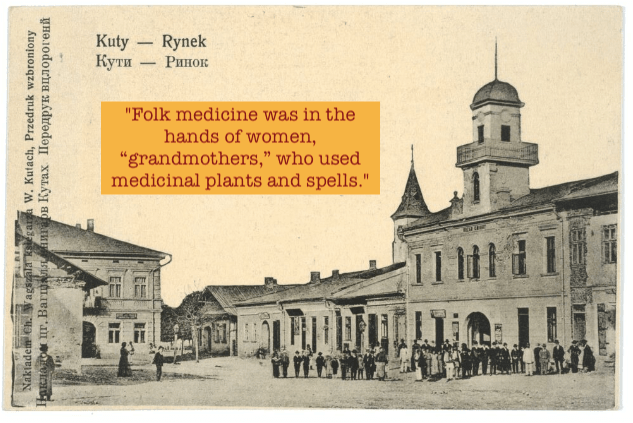
KUTY, UKRAINE
Yiddish: KITEV/קיטעוו
"Folk medicine was in the hands of women, “grandmothers,” who used medicinal plants and spells."
This matter-of-fact statement was part of a survivor's description of folk healing in Kitev before the second word war.
Another enchanting passage in the same memory book illustrates Kitev in this way:
"Geographically, the city Kittev lies in the left-hand corner of Eastern-Galicia, near the Carpathian Mountains, not far from the former Polish-Romanian border. Nature bestowed on the city an abundance of beauty. Its landscape captures the human eye. Were an artist to undertake to paint a fantastic colorful landscape, he would, it seems, be unable to paint a more beautiful landscape than Kittev was in reality."
"The city and its market-place, the shops and the Jewish streets lay on a hill. When one looked down from the hill into the valley, one saw the Dolina like a beautiful panorama in a thousand hues spreading its scattered bright houses around a green sea of aromatic flowers, gardens and orchards, with blooming and ripe fruit trees. At the foot of the Dolina there snaked the stormy mountain-stream – the Chermesh – which formed the natural boundary between Poland and Romania. The Chermesh was half covered by a belt of yellow-grey sands and green willows. From the green willows, the Kittever Moshe'lech and Shlome'lech used to cut Hoshanos, or willow branches, for Hoshanah Rabba. In the stillness of the night, you could hear in the city the rushing of the Chermesh waves and the stormy racing of its waters. From the north and west sides of Kittev, a long chain of green forests surrounded Kittev and fell in places into the valley and then rose again so high that it looked as if the tops of the trees were touching the heavens."
"In these forests, folk legend tells, the Holy Baal Shem would come to be in seclusion – to pray with the magical Nature, with the birds in the woods, with the grasses and herbs of the fields, and to pour together his soul with divine Nature."
Visit Kitev's yizkor to read more about the shtetl and the ancestors who lived here:
https://www.jewishgen.org/yizkor/kuty/kut010.html
from: https://www.jewishgen.org/yizkor/kuty1/kut043.html
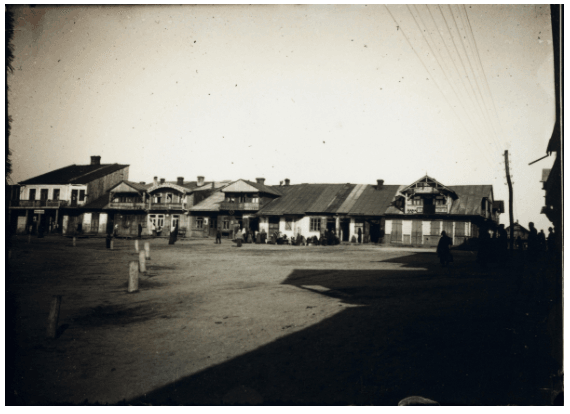
TYSZOWCE, POLAND
Yiddish: TISHIVITS/טישיוויץ
At least one grandmother healer, Gitl Shtern, a bonesetter and herbalist, and her family lived in Tishvets before the Shoah. Her story, both sad and sweet, can be found here:
https://www.jewishgen.org/yizkor/tyszowce/tys141.html#f161-1r
The Jewish presence in this shtetl dates back to the 16th century. A survivor memoirist describes Tishevits in the shtetl's yizkor:
"For close to 500 years, Tishevits was located in “Lesser Poland,” close to the crossroads of Volhynia and Ukraine, surrounded by rushing rivers, dark forests, swampy peat bogs, and sun-dazzled sands."
"Tishevits was connected to the world around it, in both territory and time, by bridges on every side, and underground caverns. With extraordinary effort, people lived and looked for answers to the world's problems from their own intellect, and dreamed the dream of the days of the Messiah."
"The wonderful deeds, and the joy, and the sad events of the generations that had lived, suffered, and hoped there, were imprinted in her alleys and her narrow interlocking little streets. The realities of today were always connected to and seen through the spiritual mysteries of yesterday."
The survivor's story continues in the link to the town's yizkor: https://www.jewishgen.org/yizkor/tyszowce/tys005.html
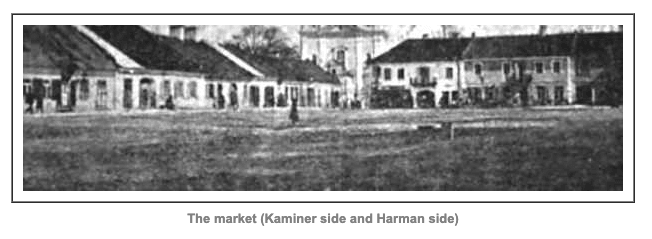
BILGORAJ POLAND
Yiddish: BILGORAY/בילגאריי
Gnendele came to Bilgoraj from Germany. She was described as wealthy yet very generous, especially when helping those in need. She was known to carry a basket of jams, yagodnik (berry) and vishnik (black cherry), for a treat for the ailing. Both of these syrups were well known herbal remedies for those with colds. Her story can be found here:
https://www.jewishgen.org/yizkor/Bilgoraj/bil181.html#Page190
Bilgoraj is well known as being the home town of literary figures I. B. and I. J. Singer.
A short description of the river that runs through the town, is remembered in the yizkor by a survivor memoirist:
"Bilgoraj had a beautiful, calm river, which snaked lazily along the entire length of the city, with green meadows and trees on both banks of the river whose willow branches were used for Hoshana Rabah. The nearby neighbors would wash their dishes after meals, and do their laundry there. There were three good places on the river to bathe: the so-called “cut-off river,” Lasse-Guri, and the “hut river.” There it was very deep, and only good swimmers bathed there. People would enjoy the warm summer days at the river."
More descriptions of Bilgoraj and the surrounding landscape can be found here:
https://www.jewishgen.org/yizkor/Bilgoraj/bil000.html#PageIII
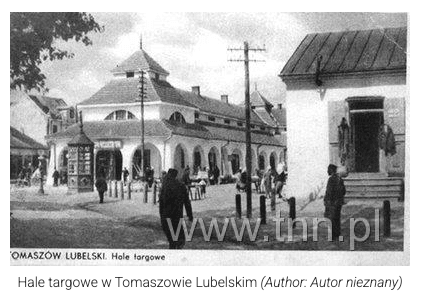
TOMASZOW-LUBELSKI, POLAND
Yiddish: TOMESHEV/TAMASHAV LUBELSK /
טאָמעשעוו / טאמאשאוו לובעלסק
So much folk medicine and so many folk healers are documented in the yizkor for this shtetl! The memoir includes linden tea, bahnkes (see earlier post on these cupping glasses), whisking "with a soft broom" (which may have been birch), wax pouring by an opshrekherin to diagnose the cause of a fright, not to mention bonesetters, feldshers, and midwives with their "homegrown remedies".
Read more about these ancestors and their traditional practices here: https://www.jewishgen.org/yizkor/Tomaszow-Lubelski2/tom273.html
This is a very long passage from the yizkor and so beautiful:
"The Cantor, and Panie Jan, accompanied by the chirping of the birds, was a concert that could only be heard during the month of Elul in the forest of Tomaszow.
Couples would wander in various corners of the forest, and dreamt of futures in the shadows of the pines amid the chirping of the birds. Teachers would teach their students the Gemara in the forest, with Tosafot, and on Tisha B'Av the students would gather mushrooms, and forest berries for the wife of the teacher. In the forest, the gentile women would gather wood used for heating during the winter. The gentile women would rake the pine needles in the forest, and use them to cover the walls in their cottages, to keep out the winter cold. In the forest, there were ant hills, such that whoever touched them with his hand, or threw pine needles on it, sensed the odor of fermentation. Everyone believed that the odor was a deterrent against headaches. Many would gather around to inhale the ants, and they struck the ant hill with their hands, moving their hands quickly to their nostrils in order to relieve themselves of any distress in the head. Children who attempted to attack the ant colony by throwing a flaming match onto the ant hill, were educated by seeing how the ants put out the fire with their saliva, without the help of fire fighters.
My father, of blessed memory, was one of the regular visitors from the city, and it was from him that I got my love of trees and plants. He would get up early on every Sabbath, and wake me up from my sleep, and took me into the forest in the capacity of his ‘bearer,’ since it was forbidden for him [sic: as an adult] to carry anything on the Sabbath. Sitting down at his regular hillock, he would look into a book until it was time to pray. When the hour of worship arrived, he would return to the city, and would go to pray at the shtibl of R' Yehoshua'leh. After noon, he would return to the forest until the Mincha prayer service time.
My father, of blessed memory, was a man of strong character, stout-hearted, and did not stop his walks in the forest, even during the days of the predations by the followers of Haller. I remember one Sabbath of those days, when I sat by his side in the forest, on his ‘hillock,’ and suddenly, at a distance from us, I saw a soldier from the Haller ranks tramping in our direction, with a drawn sword in his hand. When I tried to importune my father that we should flee, he replied: I have never fled from a man, and I am not going to now. In silence, he sat, and waited for the soldier to arrive, and when the soldier reached us, to my dismay, he asked my father, whether he was aware of a certain type of white tree from which it would be possible to make brooms. My father explained to the soldier where to go, and my soul that had nearly burst – returned to me.
Lag B'Omer was a forest day for all of the schoolchildren. All the schools, and the Heder classes, went out into the forest, as a group, under the direction of their teachers, and the melamdim, like an army going to do battle, armed with bows and arrows, full of aggressive spirit, each boy with his portion of food in his knapsack: ring cakes and a hard boiled egg, in an onion wrap, colored brown. Each ‘section’ under the oversight of its ‘leader,’ lit a campfire, ate its ‘rations,’ shot arrows, made camp and passed the time until the sun set.
Towards nightfall, a war took place between the various Heder students with stones and branches lashed together. The older boys fought without pity. One time, I came out of such a Lag B'Omer battle with a ‘mouse’ under one eye, such that my mother didn't recognize me."
To read more of the shtetl Tomaszow-Lubelski: https://www.jewishgen.org/yizkor/Tomaszow-Lubelski2/tom211.html#Page217
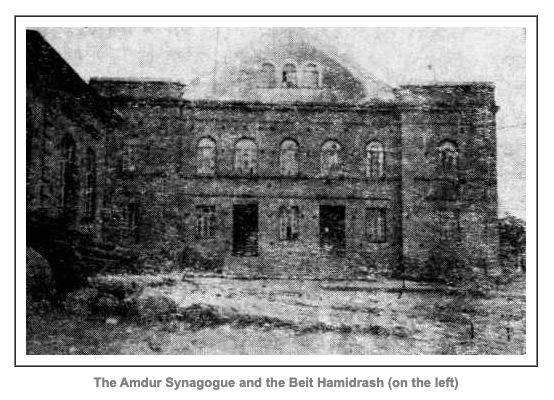
INDURA, BELARUS
Yiddish: AMDUR/אמדור
from the yizkor:
"The little shtetl Amdur, which was no more than a small dot on the map of the Lithuanian Gubernias, was the whole world in the hearts of the local Jews."
And it was home for several hundred years:
"Amdur was a Jewish town with a historical past of several hundred years, from the sixteenth century. Exactly when Jews began to settle in Amdur and when the Jewish settlement began–is not exactly known. But there is already a document from 1539 regarding claims against Amdur Jews."
Amdur was home to at least one grandmother healer prior to the Shoah:
"His wife Golde was a quack physician (in the original Yiddish she is called a "znakherke", the Slavic term for a "knower" or wise woman), a supposed healer. If a child's throat was swollen, he or she was immediately taken to Golde Hore's, or “Golde the Great,” as she was called. She would take out her lead spoon, open up the child's mouth, and immediately say to the mother, “dear Peshenke, two obstructions like potatoes.” Then she would dip her black finger into rose-honey, put it in the child's mouth, touching all the sides. The child would become green and blue, scream from the pain, and bend into thirds. Golde would devilishly move her eye, spit out three times, and say: “Feh! An ugly child” as a remedy against the evil eye. When a child would become pale and skinny, the mother would run to Golde Hore's to have her pour wax. Golde would take a pan, black from soot, and would warm something up in it. "
Golde Lasher is described in a betlittling manner but her story is interesting none-the-less because from it we learn of an herbal remedy she worked with for swollen tonsils and also a brief description of the wax pouring ceremony.
Golde's story can be found here: https://www.jewishgen.org/yizkor/indura/ind064.html
Photo credits:
Two bobbes from Horodets: https://www.jewishgen.org/yizkor/gorodets/gor167.html
Kitev market square from: cities4cities.eu/community/kuty-territorial-community/
Tishvits market square (photographer unknown) from: https://teatrnn.pl/lexicon/articles/tyszowce-the-shtetl/
Bilgoraj market square from the yizkor: jewishgen.org/Bilgoraj/bil000.html#PageIII
Tomashev-Lubelsk market halls (photographer unknown) from: teatrnn.pl
Amdur synagogue and beit hamidrash from: https://shtetlroutes.eu/en/indura-cultural-heritage-card/
