
It seems urgent in our present era to call upon the traditional women folk healer ancestors, the mysterious grandmothers who shepherdessed human life on this planet for innumerable generations and across as many miles.
Over the last few centuries, unfortunately, their secret wisdom has been so universally neglected and their practices so maligned that these healers have all but vanished at precisely the moment we need them most. Regarding the Jewish women folk healers who flourished in eastern Europe until the second world war, their particular disappearance, along with that of millions of others, was almost a fait accompli.
As an herbalist of Ashkenazi descent, it's been a thrill and an honor to reacquaint our wounded world with these forgotten guardians of the shtetls because despite their near total erasure, my co-author and I have been fortunate to catch an occasional glimpse of their mysterious lives.
Our most recent finding concerns the "secret" practices of "Grandmother Rest" and the "mysterious" remedies contained in the little basket she always carried with her.
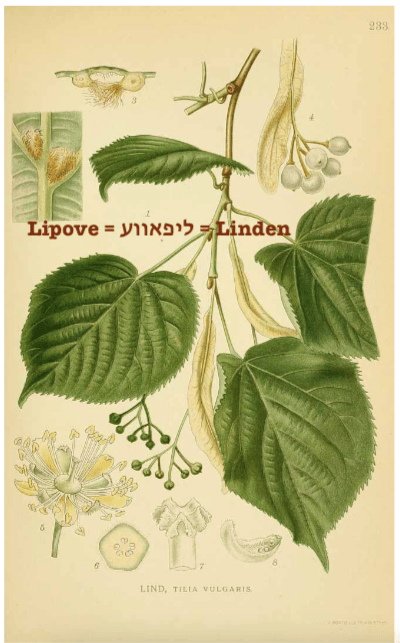
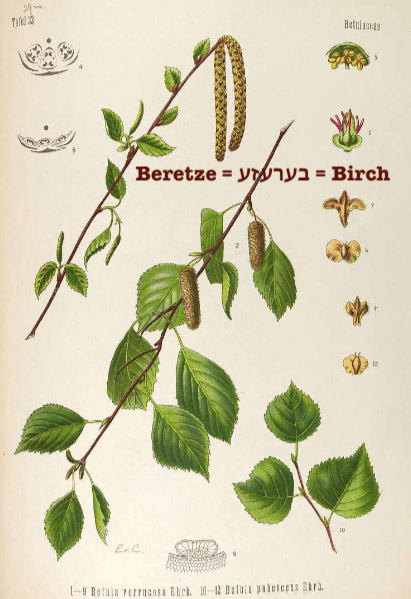
This discovery comes from a 1984 compilation of memoirs concerning the shtetls in the Volhynian region of present day Ukraine. Here we are introduced to באבע מנוחה or bobe menukhe or Grandmother Rest:
"an interesting and beloved figure in the town of Haradok (present day Horodok, Volyn Oblast of Ukraine)...both young and old knew her. She was a grandmother to everyone. Her stooped figure, with a stick in one hand and a little basket in the other, she was loved and welcomed by everyone. She used to walk slowly, maybe because of her stooping, and it used to be thought that she didn't see anyone, but, no, she saw everyone, had a kind word for everyone, and a hearty smile poured from her old wrinkled face, which was full of grace."
Perhaps the most remarkable aspect of this recollection is the casual description of her "koyshl" (קוישל) or little basket, that she always carried with her, the contents of which were kept "secret". Amazingly, the author reveals a handful of her cherished remedies, including two trusted healing herbs or kreytekher (קרייטעכצער).
"Her little basket was a געהיימעניש (geheimenish/secret). Always fully packed with flour, raisins, a little sugar, soap and other good things...And [in addition] to that, another small סודותדיק (sudusdik/mysterious) package: her medicines and tools, with which she brought a cure: a dozen bahnkes (cups for cupping), a little spirit (alcohol), washed and clean bandages, all kinds of herbs, like ליפאווע (lipove/linden) for cough, בערעזע (beretze/birch) for an open wound, האניק טייגלער (honik-teiglekh/honey-dough) for an ulcer or a boil, some old-fashioned surgical scissors to cut the umbilical cord of a newborn child from the mother."
The terms "secret" and "mysterious" are significant because they reveal just how hidden such practices were, and one of the many reasons it is so challenging to research these women's lives and work.
The few remedies of Grandmother Rest we learn of are similar if not identical to ancient herbal cures that are still in practice today, in both the eastern and the western herbal traditions.
As if to remind us that these women had many different roles in their communities, we read:
"Besides all the medicines and tools that she used against diseases, she used to remove the evil eye from those afflicted by it."
Folk healing women often embodied several roles in the shtetls. Grandmother Rest not only performed magical rituals but also applied her herbal medicinal knowledge, all in the service of healing her community. In Yiddish, aside from an old fashioned (not formally educated) midwife or "bobe" (grandmother) Grandmother Rest would have also been known as an "opshprekherin" (a female healer who speaks away an evil eye).
Grandmother Rest's skills were well appreciated throughout the region:
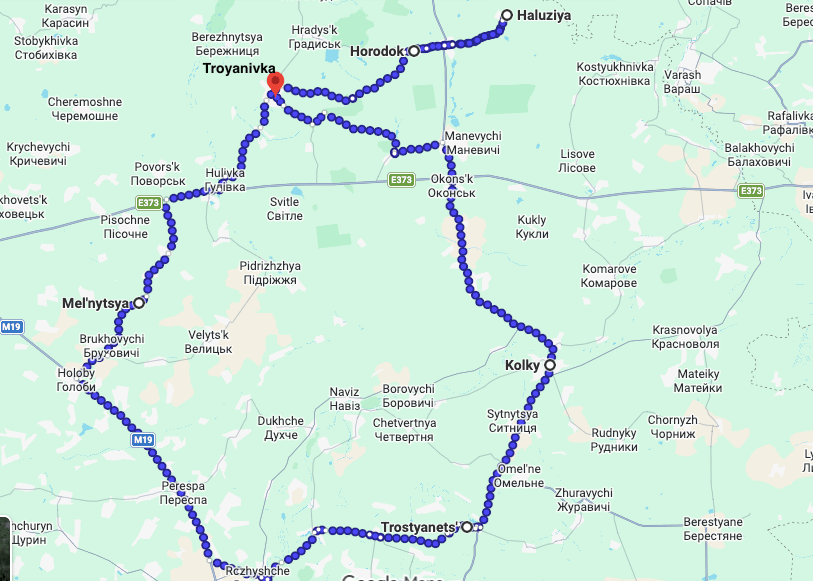
"[When] she was young, the crossing on foot from Haluzi (Haluziya, Volyn Oblast) to Haradok (Horodok, Volyn Oblast) and in the neighboring villages, was a game for her. She was known in the whole region and even far away - in Kolk (Kolky, Volyn Oblast), in Troyanovka (Troyanivka, Volyn Oblast) in Melnice (Melnytsya, Volyn Oblast), Trastiniec (Trostyanets, Volyn Oblast) and in the neighboring towns and villages."
[example: HORODOK to HALUZIYA = 6.5 miles]
I've included the map above of her routes to get a better idea of how far folk healers like Grandmother Rest traversed the lands where they lived in order to help those in need. It's no wonder there were so many cobblers and shoe stores in the shtetls!
The memoirist also includes descriptions of Grandmother Rest's other attributes, especially her tirelessness, her religious observance and her service to those in need particularly orphans, widows and the impoverished: "she was never seen sitting, she never rested."
Her non-stop industriousness makes me wonder if her name, Grandmother Rest, was an example of that inimitable Yiddish humor regarding nicknames?
Grandmother Rest was also known to cook thick potato soup in a large copper vessel. When she noticed someone concocting a soup she thought wasn't hearty enough, Grandmother Rest would comment:
"'A skinny, poor thing, you cook, my children'"...she would then "dig out a packet wrapped in paper and from there throw something into the pot to improve it, which made the potato soup tastier."
I'm guessing this must have been some herbal ingredient, possibly garlic or dill?
Grandmother Rest never asked to be reimbursed for her community service and, in fact, she was remembered for her sense of humor regarding compensation:
"And after leaving [someone's house], she would shout from the other side of the door: 'Yes, children, you already owe me a cup of milk. You hear the cows mooing. Let whoever comes down with a פאסודע (pasude/crockery jug) take milk. But remember, with a jug, you won't get any more drops of milk from me (as opposed to the cow?!)."
Her shtetl was grief-stricken when Grandmother Rest became ill and died tragically one winter because she hadn't prepared enough firewood for heating her house.
"The Jews of the town accompanied her in a mass funeral on her last journey, and eulogies were held at the shul for Grandmother Rest, who was an extraordinary figure in the town, a grandmother for everyone, young and old."
May Grandmother Rest's memory be a blessing and an inspiration to new generations of folk healers.
source:
Grandmother Rest or באבע מנוחה from: https://wolyn.org.il/%d7%99%d7%9c%d7%a7%d7%95%d7%98-%d7%95%d7%95%d7%94%d7%9c%d7%99%d7%9f-38/?asp_highlight=38&p_asid=2
photo attributions:
Vishniac, Roman, and Elie Wiesel. 1983. A Vanished World. First edition. New York: Farrar, Straus & Giroux. (basement storefront, Vilnius, 1937 p. 108)
Linden: Tilia europaea J. Zorn, D.L. Oskamp, Afb. Arts.-Gew., vol. 4 1800 (from botanicalillustrations.org)
Birch: Betula pendula Roth F.E. Köhler, Med.-Pfl., vol. 4 (from botanicalillustrations.org)
