
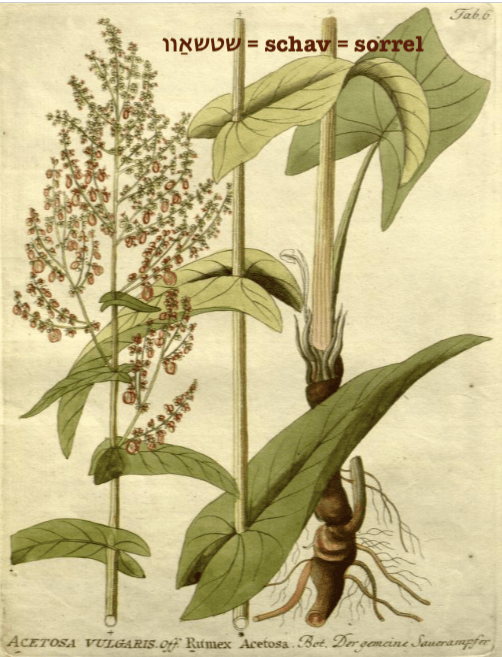
Does the word "schav" sound familiar? If it conjures visions of a cold, green soup, you might be surprised to learn that the plant, Rumex acetosa, or sorrel, is the main ingredient for this herbal concoction.
Decades ago, while on a walk with my totally urban, beloved grandmother, out of the blue, she stopped in mid stroll and bent down to pick the leaves from a little plant growing on the edge of the sidewalk. Hours later, I had my first taste of schav, the well-known cold sour soup of the shtetl.
In Yiddish schav translates to the English sorrel, or sour grass. Sorrel is one of the plants known by English speaking herbalists as "docks". Docks are traditionally worked with for digestive health. And, as we've noted in our books, especially Woven Roots, digestion was the most important aspect of health for folk healers in the Pale of Settlement.

My grandmother made a recipe she'd memorized that called for the raw egg to be added in separately, but Arthur Schwartz's book includes both the raw and the hard boiled versions of the soup. Both recipes can be found here.

If you'd like to learn more about sorrel in the both the Old Country and the New, this article from the Forward is very interesting.
And here's a contemporary article on the medicinal qualities our grandmothers surely intuited about schav when they cooked this delicious springtime meal.
Photo credits:
*Didier Descouens
*Missouri Botanical Gardens
*Arthur Schwartz's Jewish Home Cooking published in 2008 by Ten Speed Press
