
Plica Polonica image at top of post from wikicommons
Preface
As an herbalist of Ashkenazi descent, I've been very interested in the plant medicine known by the Jews of Eastern Europe prior to the Shoah. While researching these traditions, it's become clear to me that the women of that time and place have been the most obscure of the folk healers, and, that their healing methods are much different from the medicine practiced by men of their era. Like so many women folk healers the world over, their traditions were seldom written down, but rather transmitted in a kind of apprenticeship relationship: elders teaching each successive generation the skills and knowledge needed to keep their communities safe and well. For reasons specific to the Ashkenazim, it has been rare to find even a stray reference to the Jewish women healers who flourished in eastern Europe, let alone the plants or methods they employed. However, if a researcher is patient, little embers of wisdom can still be uncovered, smoldering in the most unexpected places. One rare glimpse of an Ashkenazi woman folk healer comes from an early modern Hebrew medical text, embedded within the description of a now extinct disease, which, at the time, caused much pain and suffering for its victims.
The Kaltine
As late as the early 20th century, many people were afflicted with a mysterious medical condition that manifested as matted hair. The illness was known by several names, depending on the region where it proliferated.
Because it was believed to occur mainly In Polish lands, medical professionals dubbed it in Latin, Plica Polonica, or Polish Plait. There, Slavic speakers knew the condition as the "koltun". In Germany, "Haar-Locken" described it, and even in English speaking lands it might be recognized as an "elf-lock". Yet regardless of its locale the condition was believed to be the result of supernatural forces that had taken refuge in the hair.
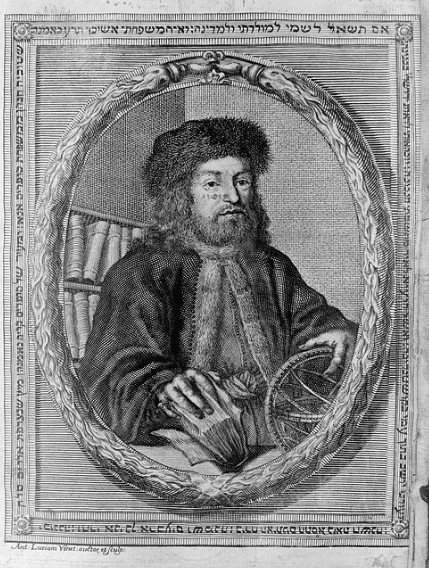
Tobias Hakohen image from wikicommons
Tobias Hakohen, the well-travelled Jewish physician and polymath of the early 18th century, was the first to write about the disease in Hebrew. In his work, Ma'aseh Tuvia, Hakohen identifies the condition's Yiddish name as קאלטינע or "kaltine" and characterizes the matted strands as "the glutination of hairs and their joining together like a rope". Based on his description of possible causes, symptoms and optional treatments, it's clear Hakohen had studied this disease in depth and hoped to offer some understanding and ultimate relief to his co-religionists.
"The main symptoms," Hakohen writes, "include sticking together of the hair, terrible headache, many parasites, cramps, breaking of the loins, looseness of the vertebrae, pain in the joints. Sometimes nodules occur in the fingers, in some, the nails grow long and black, like goat's horns. In some the matting is most pronounced in the beard so that it is necessary to hide the beard under the clothing."
He surmises that the knot seemed to affect women who didn't experience regular menstruation, but overall, he concedes, it is common in "both men and women, old and young, weak and strong, rich and poor" and once the condition was established it created further physical hardships for those who bore it.
Many physicians at the time theorized on the cause of the disease. For example, Hakohen notes that some doctors claimed the culprit was taking the "waters flowing between the mountains of Hungary that branched out into many areas of Poland". But, Hakohen argues, if this were the case, more people in Hungary would be afflicted with the illness. Other experts, he writes, speculate on the influence of the planets; but, here again, Hakohen invokes both logic and his own religious convictions, especially Talmudic writings, to cast doubt on this theory.
Another possible cause, he surmises, is "coarse, spicy and salty foods", but then notes that scurvy, which was associated with these substances, didn't prevail in Polish lands.
Regardless of the kaltine's source, Hakohen offers readers three possible approaches to treat the malady.
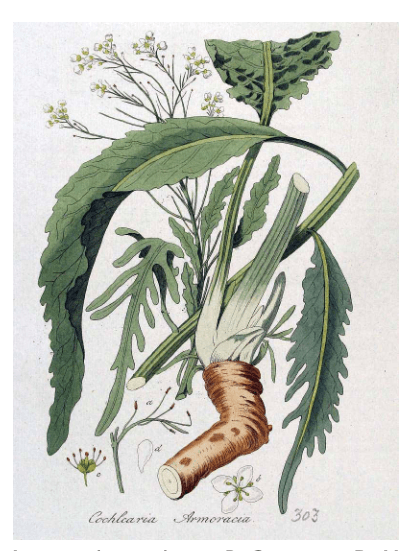
Horeseradish illustration contributed by BioLib.de from botanicalillustrations.org
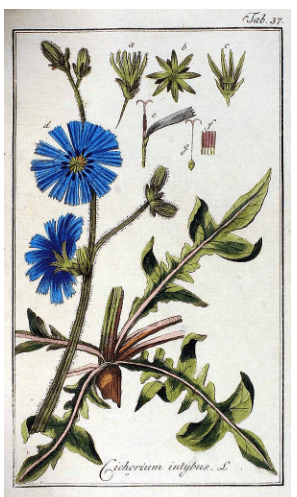
Chicory illutration contributed by www.BioLib.de from botanicalillustrations.org
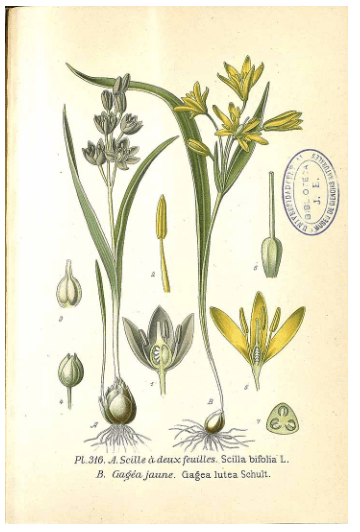
Squill illustration contributed by: Real Jardin Botánico, Madrid, Spain from: botanicalillustrations.org
The first is a very rigorous series of actions that are meant to purge a victim of all potentially offending toxins with the ultimate goal of strengthening the body enough to rid itself of the knot. Initial formulations in his regimen call for the clearing of the digestive tract by inducing vomiting, diarrhea and even sneezing. Horseradish, absinthium, chicory, iris root, marjoram, black cumin and snuff, plants of varying strengths and abilities are meant to expel offending substances from a victim's body. For rinsing the throat afterwards, he recommends a tea of pennyroyal, oregano, and hyssop, among other aromatic herbs. Next, a decoction for protecting and strengthening the brain is advised to be made with herbs including vervain, sage, and paeony. The scalp can then be softened with almond oil, goose or chicken lard, but the best is rosemary oil and Hungary water (could this be "Queen of Hungary Water"?). As his prescription winds down, more toxic herbs like lousewort are considered for removing parasites. Finally, Hakohen suggests therapies popular in his time such as bloodletting or a mercury treatment if necessary. Throughout, he recommends taking chicken soup to refresh and restore the body.
The second option Hakohen offers for patients who suspects the work of evil spirits. Here he invokes the old physicians who were well known to employ incense such as myrrh in combatting spells and poisonous air. He quotes Pliny regarding squill or sea onion, which was hung in the corner of a house to ward off any evil entities, although, "we (Jews), as a holy people, believe the testimony of the book of Zohar, in the chapter of Pynchas, that witchcraft flees from the mezuzah and that YHWH protects the innocent".
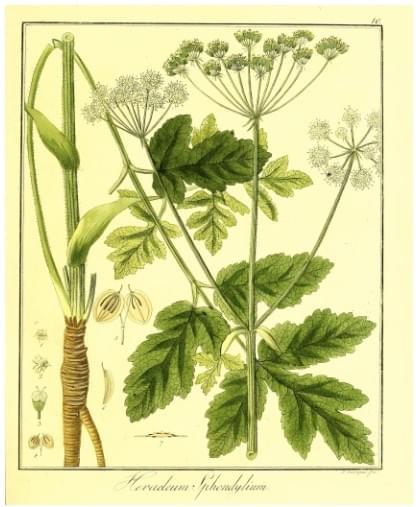
Cow parsnip illustration contributed by BioLib.de from botanicalillustrations.org
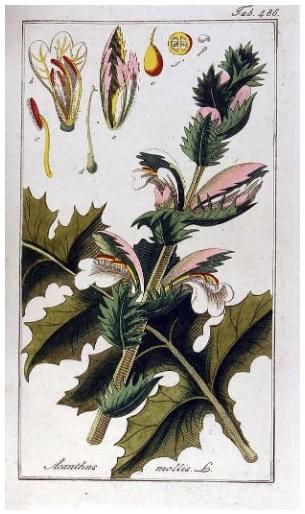
Acanthus illustration contributed by Harvard University Botany Libraries, Cambridge, USA from botanicalillustrations.org
For an herbalist of Ashkenazi descent, Hakohen's third possibility is the most significant because it brings to light the rarely acknowledged Jewish woman folk healer and her ancient medicinal plant knowledge. At the conclusion of Hakohen's essay on the Plica Polonica, he recounts a story his father had told to him. The brief tale is another example of the dismissive way women folk healers have been treated through the centuries, effectively erasing their existence. Yet, it's in these indifferent stories that can be discerned the faint traces of their lives and practices.
The story recalls a person who had suffered with a kaltine for twenty-two years. After many expensive unsuccessful treatments given by various academy-trained physicians, this person was finally cured by an older woman healer from the shtetl, known in Yiddish as an "opshprekherin" or a "bobe".
To preface the tale, Hakohen apprises his audience that the people in these Polish lands are very superstitious and look to amulets and "oaths" to combat demons; however, he himself does not indulge in such beliefs in the supernatural. A close reading of this statement suggests that the elder woman would have begun her treatment of the patient by directly addressing any otherworldly entities that had invaded the victim and caused the kaltine. In other words, she would have invoked magical rituals and or incantations or "oaths" before prescribing an herbal remedy.
Fortunately for contemporary herbalists, Hakohen then recounts the elder's secret herbal remedy, one that finally brought relief to the long-suffering patient. The plants from her prescription include ash from burnt peas along with a plant known in Yiddish as בארשץ or borshts. Hakohen also identifies the plant in Latin as "Branca ursi", or bear claws.
While it's exciting to read such a detailed remedy, it's also frustrating because the plant בארשץ or Branca ursi refers to not one, but two plants.
According to Mordkhe Schaechter's Plant Names in Yiddish, Cow Parsnip (Heracleum ) is known as באָרשטש or borshtsh. This plant, which we write about in our book Woven Roots, was also an ingredient in the well-known soup of the same name.
בארשץ or borshts, can also refer to the plant Acanthus, which, in Old Ukrainian, was known as борщъ or borshch.
To further complicate the exploration of the elder healer's formula, a 19th century study of the Plica Polonica reveals that the 16th century Polish physician and botanist, Simon Syrenius recommended a combination of both Cow Parsnip and Acanthus combined with Lycopodium, for treating the Plica Polonica.
Regardless of the formula's complicated background, the elder woman's method was far less complicated than Hakohen's and proved successful where more "advanced" prescriptions had failed.
This anecdote is a tiny glimpse not only into the wide ranging healing skills these women possessed but also the complexity involved in rediscovering and disentangling their mysterious practices.
Stay tuned for another example of another newly discovered glimpse into the work of the opshprekherin.
Sources:
Kats, Ṭoviyah. 1708. Ma’aseh Toviyah. [Venezia].
Mortkhe Shekhṭer, שעכטער, מרדכי., Mortkhe Shekhṭer, and Mordkhe Schaechter. 2005. דיגעוויקסן־וועלטאיןיידיש. Nyu-Yorḳ: Yidisher ṿisnshafṭlekher insṭiṭuṭ-Yiṿo.
Rosenberg, Heinrich. 1839. Der Weichselzopf : eine theoretisch-practische Abhandlung sammt einer pragmatischen Geschichte desselben treu nach der Natur beobachtet und nach homöopathischen Grundsätzen. München: Druck und Verlag von Georg Franz.
